Have you ever gone camping far from any city and been shocked by how many stars are in the sky? That brilliant, dense tapestry of light is what the night sky is supposed to look like. For the majority of people living in or near urban centers, that view is lost to something called light pollution.
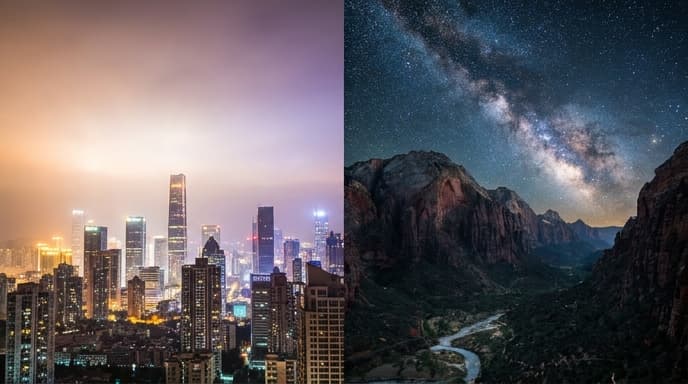
Understanding what light pollution is and how to get away from it is the single most important step you can take to improve your stargazing. It's more crucial than buying a bigger telescope or a fancier camera. Here's what you need to know.
What Is Light Pollution?
Light pollution, in its simplest form, is the excessive or misdirected use of artificial light at night. It comes from streetlights, office buildings, billboards, and sports stadiums. This light doesn't just illuminate the ground; it also shines upwards into the atmosphere, where it scatters off air molecules and dust.
This scattering creates a diffuse, bright haze called sky glow. It's this dome of orange or white light you see over cities at night. Sky glow drastically reduces the contrast between the stars and the sky itself, effectively washing out all but the very brightest stars and planets from our view.
How We Measure Dark Skies: The Bortle Scale
To help astronomers classify the quality of a night sky, a scale called the Bortle Scale is used. It runs from Class 1 (the darkest skies available on Earth) to Class 9 (an inner-city sky).
- Class 8-9 (Inner City): You can see the Moon, planets, and maybe a few dozen of the brightest stars. The sky looks orange or gray, not black.
- Class 6-7 (Suburban): You can see several hundred stars and easily make out major constellations like the Big Dipper and Orion. The Milky Way is invisible or only faintly visible on the clearest nights.
- Class 4-5 (Rural): This is where stargazing gets good. The Milky Way becomes visible as a faint, cloud-like structure. Thousands of stars are visible.
- Class 1-3 (Truly Dark Sky): The Milky Way is so bright it can cast a faint shadow. The view is incredibly detailed, filled with countless stars and dark dust lanes. These locations are typically found in remote national parks or deserts.
How to Find a Dark Sky Near You
You don't have to travel to a remote desert to get a better view. Often, just a 30- to 60-minute drive out of the city can take you from a Bortle Class 7 sky to a Class 4, making a world of difference. The key is to use a light pollution map.
There are several websites and apps that provide detailed maps of light pollution across the globe. A popular choice is lightpollutionmap.info.
- Go to the Website: Open the map on your browser. It will show a color-coded overlay on a map of your area.
- Understand the Colors: The colors correspond to the Bortle Scale. White, red, and orange areas are cities and major suburbs with the worst light pollution. Yellow and green areas are better, and blue or gray areas are excellent.
- Find Your Spot: Look for the nearest green, blue, or gray area. Cross-reference this with a regular map to find a public place you can safely visit at night, like a state park, a conservation area, or a quiet country road with a safe place to pull over.
- Check the Moon Phase: Even in a dark location, a full moon will act like a giant, natural streetlight, washing out fainter stars. For the best stargazing, plan your trips around the new moon.
Frequently Asked Questions
Can I do anything about light pollution in my own home?
Yes. You can contribute to the solution by using outdoor lights that are shielded and point downwards, so they only illuminate the ground where it's needed. Use lower-intensity bulbs and turn off lights when they aren't in use.
Are there official 'dark sky' places?
Yes. The International Dark-Sky Association (IDA) designates certain areas as International Dark Sky Parks, Reserves, and Sanctuaries. These places are protected for their scientific, natural, and cultural value and offer some of the best stargazing in the world.
Does weather affect light pollution?
Yes. Clouds can make sky glow much worse by reflecting the city lights back down. A clear, dry night is always best for stargazing.
Key Takeaways
- Light pollution is artificial light from cities scattering in the atmosphere, creating a bright haze called sky glow.
- Sky glow drastically reduces the number of visible stars.
- The Bortle Scale measures sky darkness from Class 9 (inner city) to Class 1 (pristine).
- Use an online light pollution map to find nearby parks or rural areas with darker skies.
- For the best experience, go stargazing on a clear night near the new moon.
Related Reading
- How to Take Your First Night Sky Photo With Your Phone
- Telescope vs. Binoculars: What's Best for a Stargazing Beginner?
- A Beginner's Guide to Using Stargazing Apps on Your Phone