You've used stargazing apps to learn the constellations and now you're hooked. You want to see more detail: the craters on the Moon, the moons of Jupiter, or the faint glow of a distant nebula. It's time for your first piece of optical gear. The two main choices are a telescope and a pair of binoculars, and the right answer for a beginner is often not what you'd expect.
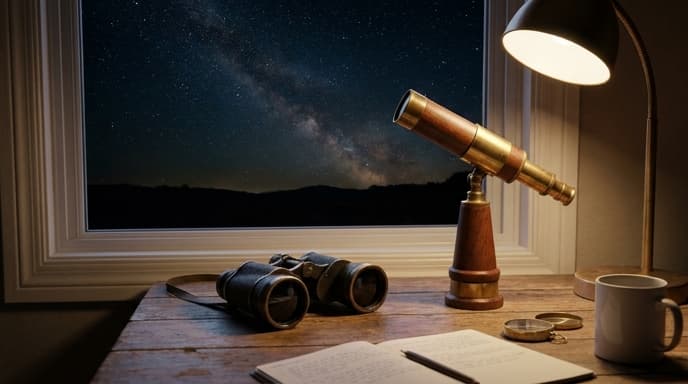
While a powerful telescope is the ultimate goal for many amateur astronomers, a good pair of binoculars is frequently the more practical and rewarding first step. Let's break down why.
The Case for Binoculars
Don't underestimate them. A decent pair of binoculars can reveal a staggering amount of detail in the night sky and has several key advantages for someone just starting out.
- Ease of Use: You already know how to use binoculars. You just point them at what you want to see and focus. There's no complicated setup, alignment, or confusing eyepieces to deal with. This immediacy makes them much less intimidating.
- Wide Field of View: Binoculars show you a much wider patch of sky than a telescope. This makes it incredibly easy to find what you're looking for. It's perfect for scanning the Milky Way, tracking a satellite, or learning your way around constellations.
- Portability and Cost: Good astronomy binoculars are significantly cheaper and more portable than a decent beginner telescope. You're more likely to take them with you on a camping trip or a drive to a dark sky site.
What to look for: For astronomy, look for binoculars described by two numbers, such as 7x50 or 10x50. The first number is the magnification (7x or 10x), and the second is the diameter of the front lenses in millimeters (the aperture). A 50mm aperture is great for gathering light from faint objects. A magnification of 7x or 10x is ideal; any higher becomes very difficult to hold steady.
The Case for a Telescope
A telescope's main job is to do two things: gather lots of light and provide high magnification. This is where it outshines binoculars.
- High Magnification: If you want to see details on the surface of Mars, the rings of Saturn, or the cloud bands of Jupiter, you need the high magnification that only a telescope can provide.
- Light Gathering Power: Telescopes have much larger apertures (main lens or mirror) than binoculars. This allows them to gather more light, making it possible to see much fainter objects like distant galaxies and nebulae.
- A Stable Platform: Every telescope comes with a mount or tripod, providing the stable base needed for viewing at high magnifications.
What to look for: A good beginner telescope is often a Dobsonian reflector. They have a simple, sturdy design and offer the largest aperture for your money, making them excellent for viewing a wide range of objects.
What Can You See With Each?
With 10x50 Binoculars, you can clearly see:
- Craters and mountains on the Moon.
- The four largest moons of Jupiter.
- The crescent shape of Venus.
- Star clusters like the Pleiades.
- The Andromeda Galaxy (as a faint, fuzzy patch).
- Large, bright nebulae like the Orion Nebula.
With a small beginner telescope (e.g., a 4.5-inch reflector), you can see all of the above, plus:
- The rings of Saturn.
- The cloud bands on Jupiter.
- The polar ice caps on Mars (when it's close to Earth).
- Individual stars within star clusters.
- More detail and structure in nebulae and galaxies.
Frequently Asked Questions
Is more magnification always better?
No. High magnification also magnifies any shakiness in the mount and atmospheric turbulence, often resulting in a blurry, wobbly image. It also makes the field of view very narrow, making objects hard to find. It's often better to use a lower-power eyepiece for a sharp, wide view.
Why not just use one half of a pair of binoculars?
This is called a monocular. While they exist, using two eyes is more comfortable for long viewing sessions and provides a more immersive, slightly brighter image.
Should I buy a cheap department store telescope?
It's generally advised to avoid very cheap, all-in-one telescope packages that advertise huge magnification numbers (like 500x). They often have poor quality optics and flimsy mounts, leading to a frustrating experience. A good pair of binoculars is a much better investment than a bad telescope.
Key Takeaways
- For most beginners, binoculars are the best first instrument for astronomy.
- Binoculars are affordable, portable, and easy to use, with a wide field of view that makes finding objects simple.
- A good pair of 7x50 or 10x50 binoculars can reveal craters on the moon, Jupiter's moons, and star clusters.
- Telescopes offer higher magnification and gather more light, which is necessary for seeing details on planets and faint deep-sky objects.
- A quality pair of binoculars is a better purchase than a low-quality, high-magnification telescope from a department store.
Related Reading
- A Beginner's Guide to Using Stargazing Apps on Your Phone
- How to Use a Star Chart or App to Find Constellations
- Understanding Light Pollution and How to Escape It