Looking up at the night sky, it's easy to feel lost. How do you go from a seemingly random assortment of bright dots to recognizing the mythical figures and shapes of the constellations? The secret is to not try to learn everything at once. Instead, you learn a few key landmarks and use them to navigate to everything else.
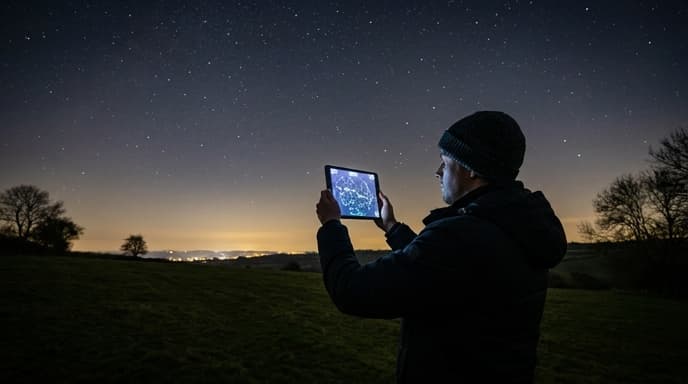
This technique is called star hopping. It's a simple and rewarding way to learn the sky, and it all starts with finding one famous group of stars. This guide is focused on the Northern Hemisphere sky; navigation in the Southern Hemisphere uses different anchor points.
Step 1: Find the Big Dipper
Your first and most important landmark is the Big Dipper. It isn't technically a constellation itself, but an 'asterism' (a prominent pattern of stars) within the constellation Ursa Major, the Great Bear. It's one of the most recognizable shapes in the sky and is visible year-round from most northern latitudes.
Look to the northern part of the sky for a pattern of seven bright stars that looks like a large spoon or saucepan. It has four stars that form a 'bowl' and three that form a 'handle'.
Step 2: Use the Pointer Stars to Find Polaris
The Big Dipper's most important job is to point you to the most important star in the northern sky: Polaris, the North Star. Polaris is special because it sits almost directly above the Earth's North Pole. This means that as the Earth turns, Polaris stays in the same spot all night long, while all the other stars appear to revolve around it.
To find it, look at the two stars that form the front edge of the Big Dipper's bowl (the side opposite the handle). These are the 'pointer stars', Dubhe and Merak. Imagine a straight line connecting these two stars and extend it upwards out of the bowl. Continue that line across the sky for about five times the distance between the two pointer stars. The first moderately bright star you come to is Polaris.
Step 3: Start Star Hopping
Once you can reliably find the Big Dipper and Polaris, you have your bearings. Now you can use them to find other constellations.
- Finding Cassiopeia: Polaris sits roughly halfway between the Big Dipper and another easily recognizable constellation, Cassiopeia. If you look on the opposite side of Polaris from the Big Dipper, you'll find a group of five bright stars that form a distinct 'W' or 'M' shape. That's Cassiopeia.
- Finding Boötes: Go back to the Big Dipper. Follow the curve of its handle away from the bowl. The saying goes, 'Arc to Arcturus.' Following that arc will lead you to a very bright, orange-tinted star. That's Arcturus, the brightest star in the constellation Boötes, the Herdsman.
- Finding Leo: You can also use the pointer stars in the other direction. If you draw a line from them downwards, away from Polaris, you'll point towards the constellation Leo, the Lion, which is prominent in the spring sky.
Using Tools to Help
You don't have to do it all by memory. A star chart, or planisphere, is a great physical tool. It's a rotating star map that you can set to the current date and time to see what's visible. Of course, stargazing apps on your phone do this automatically and can help you confirm that you've hopped to the right place.
Frequently Asked Questions
Why can't I see the Big Dipper?
Depending on the time of year and your latitude, the Big Dipper might be very low on the northern horizon and possibly obscured by trees or buildings. Because it circles Polaris, if you wait a few hours, it will be higher in the sky. In the autumn, it can be particularly low.
Is Polaris the brightest star in the sky?
No, not even close. It's only about the 50th brightest star. Its importance comes entirely from its fixed position in the sky, not its brightness.
Does this work in Australia or South America?
No. Polaris and the Big Dipper are not visible from the Southern Hemisphere. Observers there use different guideposts, like the Southern Cross and the Magellanic Clouds, to navigate the sky.
Key Takeaways
- Star hopping is the technique of using familiar star patterns to find new constellations.
- In the Northern Hemisphere, your primary landmark is the Big Dipper.
- Use the two 'pointer stars' in the bowl of the Big Dipper to draw a line straight to Polaris, the North Star.
- Once you have Polaris, you can use the Big Dipper as a reference to find other constellations like Cassiopeia and Boötes.
- A stargazing app can help you confirm your location and learn new star hops.
Related Reading
- A Beginner's Guide to Using Stargazing Apps on Your Phone
- Telescope vs. Binoculars: What's Best for a Stargazing Beginner?
- How to Safely Update Your Graphics Card Drivers (NVIDIA & AMD)